
Constitutional Foundations and Judicial Review
Constitutional Foundations and Judicial Review
Legal treatise · Constitutional Law
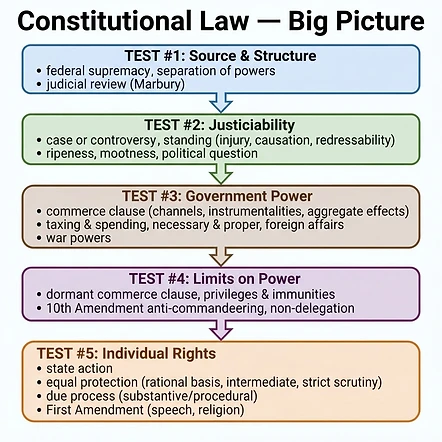
Nature and Sources of Constitutional Law
Constitutional law governs the allocation of power between the branches of the federal government, the relationship between the federal government and the states, and the protection of individual rights. The primary source is the United States Constitution, including the Bill of Rights and subsequent amendments. Judicial interpretation by the Supreme Court provides the authoritative meaning of these provisions. When studying for the MBE, focus on the concept of Judicial Review, which empowers federal courts to declare legislative and executive acts unconstitutional, a power established in Marbury v. Madison.
Justiciability and Federal Court Jurisdiction
For a federal court to hear a case, it must meet Justiciability requirements. The plaintiff must have Standing, which requires an injury-in-fact, causation, and redressability. Furthermore, the case must be ripe and not moot. The court will not hear political questions, which are issues assigned to other branches of government by the Constitution. Understand that federal courts are courts of limited jurisdiction and cannot offer advisory opinions.
Congressional Power and Commerce Clause
Congress possesses enumerated powers, primarily found in Article I, Section 8. The most expansive is the Commerce Clause, which permits Congress to regulate the channels of interstate commerce, instrumentalities of interstate commerce, and activities that have a substantial economic effect on interstate commerce. The Necessary and Proper Clause allows Congress to execute its enumerated powers through any non-prohibited means that are rationally related to a legitimate federal end.
Executive and State Power
The President possesses powers granted by Article II, including authority as Commander in Chief and the power to enforce federal law. Executive power is at its zenith when acting with Congressional approval and at its nadir when acting against the express will of Congress. Conversely, states retain Police Power to regulate for the health, safety, and welfare of their citizens, provided the regulations do not conflict with federal law under the Supremacy Clause.
Dormant Commerce Clause and Privileges and Immunities
The Dormant Commerce Clause prohibits states from passing legislation that improperly burdens or discriminates against interstate commerce. If a state law is discriminatory on its face, it is subject to Strict Scrutiny and will generally be struck down unless the state can prove it is necessary to achieve an important government interest. The Privileges and Immunities Clause of Article IV protects citizens of other states from being discriminated against by a state in regard to fundamental rights or essential economic activities.
Individual Rights and Due Process
The Fifth and Fourteenth Amendments guarantee Due Process. Procedural due process requires notice and an opportunity to be heard before the government deprives a person of life, liberty, or property. Substantive Due Process protects fundamental rights, such as marriage, procreation, and child-rearing, from government interference. Laws affecting fundamental rights are subject to strict scrutiny, while non-fundamental rights are subject to the Rational Basis test.
Equal Protection Clause
The Equal Protection Clause of the Fourteenth Amendment prohibits states from denying persons the equal protection of the laws. Analysis involves determining the level of scrutiny. Strict Scrutiny applies to suspect classifications like race or national origin. Intermediate Scrutiny applies to quasi-suspect classifications like gender or illegitimacy. All other classifications, including age or economic status, are reviewed under the Rational Basis standard, requiring only that the law be rationally related to a legitimate interest.
First Amendment Protections
The First Amendment protects freedom of speech and religion. Content-based restrictions on speech are generally subject to strict scrutiny. Time, place, and manner restrictions on speech in public forums must be content-neutral, narrowly tailored to serve a significant government interest, and leave open alternative channels of communication. Commercial Speech is subject to intermediate scrutiny, provided it is not false or misleading and concerns lawful activity.
Constitutional Law: Added Rules and Exam Tips
Justiciability and Federal Judicial Power
- Standing: injury that is concrete and personal, causation and redressability, no third-party standing (exceptions: close relationship, injured party unlikely to sue, and organizational standing when members would have standing, the interest is germane, and no individual participation is needed), and no generalized grievances as a citizen or taxpayer (taxpayers may challenge spending under the Establishment Clause).
- Ripeness asks about hardship without review and fitness of the record. Mootness bars cases whose injury ended, except wrongs capable of repetition yet evading review, voluntary cessation, and class actions with a live member.
- Political questions: republican form of government, foreign-policy conduct, impeachment process, and partisan gerrymandering.
- Supreme Court review: certiorari for nearly all cases; no review where a state decision rests on an independent and adequate state-law ground.
- The Eleventh Amendment bars suits against states in federal court (exceptions: explicit waiver, Section 5 of the Fourteenth Amendment legislation, suits by the federal government, bankruptcy). Suits against state officers for injunctions, or for damages from their own pockets, are allowed.
Congressional and Executive Power
- No general federal police power. Congress may use the Necessary and Proper Clause, tax and spend for the general welfare, and regulate the channels and instrumentalities of commerce and economic activity with a substantial aggregate effect.
- Tenth Amendment: Congress cannot commandeer state legislatures or officials, but may attach clearly stated, related conditions to grants.
- Section 5 of the Fourteenth Amendment: Congress may remedy, not create, rights, and its remedy must be congruent and proportional.
- Delegation of legislative power is almost never a winning argument. Legislative vetoes and line-item vetoes are invalid (bicameralism and presentment). Congress cannot give itself executive or appointment power.
- Treaties need Senate approval; executive agreements do not. Both beat conflicting state law; a later federal statute beats either; the Constitution beats all. Exam shortcut on foreign affairs: political question first, president wins second.
- Appointments: president nominates, Senate confirms; Congress may vest inferior officers in the president, department heads, or courts. Removal is at will unless Congress validly limits it for good cause in an office needing independence.
- Impeachment: House by majority, Senate conviction by two-thirds. The president has civil immunity for official acts, executive privilege that yields to important interests, and a pardon power for federal crimes only (not state, not civil, not impeachment).
Federalism
- Preemption: express, field or conflict (mutually exclusive, impedes federal objective, or clear congressional intent). States cannot tax or regulate the federal government directly.
- Dormant Commerce Clause (negative implication): a discriminatory state law survives only if necessary to an important interest; a neutral law is balanced (burden versus benefit). Exceptions: congressional approval and the market-participant doctrine.
- Privileges and Immunities Clause of Article IV: applies only to discrimination against out-of-staters regarding civil liberties or important economic activity; corporations and aliens cannot invoke it. It differs from the Fourteenth Amendment clause, which is nearly always a wrong answer except for the right to travel.
- Full Faith and Credit: final, merits judgments from courts with jurisdiction.
State Action
- The Constitution binds only government. Exceptions: public function (traditionally and exclusively governmental) and entanglement (government encourages or facilitates the conduct). Congress may reach private conduct through the Thirteenth Amendment or the Commerce Power, not Section 5.
- Bill of Rights incorporation excludes the Second Amendment (now incorporated), the Third, the Fifth grand jury clause, and the Seventh civil jury right.
Levels of Scrutiny
- Rational basis: legitimate conceivable purpose, rational means, burden on challenger. Intermediate: important actual purpose, substantially related means, burden on government. Strict: compelling actual purpose, necessary means, least restrictive alternative, burden on government.
Due Process
- Procedural: ask (1) was there a deprivation of life, liberty, or property (entitlement requires a reasonable expectation of continued benefit), then (2) what process is due by balancing the private interest, risk of error and value of added procedure, and the government's interest. Mere negligence does not deprive.
- Substantive: economic regulation gets rational basis. Takings: possessory or regulatory (no viable economic use), public use is broadly read, just compensation measures the owner's loss. Contracts Clause applies only to states and requires a reasonable, narrowly tailored measure for private contracts and closer scrutiny for government contracts. Fundamental rights (marriage, procreation, child custody and upbringing, contraception, family living arrangements) get strict scrutiny; abortion uses the undue-burden test before viability; no right to physician-assisted suicide; competent adults may refuse treatment and states may require clear and convincing proof of an incompetent patient's wishes.
Equal Protection
- Classification, scrutiny level, then fit. Race and national origin: strict scrutiny, and a facially neutral law needs discriminatory impact plus intent. Alienage: strict generally, rational basis for political-function jobs and for federal action. Gender and non-marital children: intermediate (gender requires an exceedingly persuasive justification). Everything else (age, disability, wealth, sexual orientation, economics): rational basis.
- Fundamental rights under Equal Protection: travel (residency waiting periods fail), voting (one person one vote, race as predominant factor in districting), but no fundamental right to education.
First Amendment
- Content-based restrictions get strict scrutiny; content-neutral get intermediate. Prior restraints are presumptively invalid (no gag orders on the press). Vagueness and overbreadth invalidate laws. Symbolic speech: regulation must serve an interest unrelated to suppression and be no broader than needed. Incitement requires imminence and likelihood.
- Obscenity: prurient interest, patently offensive, lacks serious value; child pornography may be banned outright; private possession of obscene material is protected.
- Commercial speech: false or illegal advertising is unprotected; otherwise regulation must be narrowly tailored but not least restrictive.
- Defamation: public officials and figures must prove falsity and actual malice; private figures on public concern must prove falsity and negligence (presumed or punitive damages need actual malice).
- Forums: public and designated forums allow content-neutral time, place, and manner rules with alternatives; nonpublic forums require reasonableness and viewpoint neutrality.
- Association: punishing membership requires active affiliation, knowledge, and specific intent; compelled disclosure that chills association gets strict scrutiny.
- Religion: Free Exercise cannot defeat a neutral law of general applicability. Establishment Clause: secular purpose, no primary advancing or inhibiting effect, no excessive entanglement; school-sponsored prayer is barred, but equal access for religious groups is required.
Exam Tips
- Ask first: which actor (Congress, president, courts, state, private), then which limit. Look for the answer that names the right doctrine, and distrust answers built on rights versus privileges, delegation, or the Fourteenth Amendment Privileges or Immunities Clause.
Master Outline Add-On: Constitutional Law
- Justiciability. Standing needs concrete injury, causation, and redressability; ripeness and mootness also limit federal courts. Exam cue: Check organizational and third-party standing.
- Congressional powers. Enumerated powers include commerce, taxing, spending, and enforcing the Reconstruction Amendments; federal action must fit a grant. Exam cue: Differentiate commerce regulation from conditional spending.
- Federalism. Preemption displaces conflicting state law; the dormant Commerce Clause limits discriminatory or unduly burdensome state laws. Exam cue: Check for congressional authorization and exceptions.
- Equal protection. Strict scrutiny for race and some fundamental rights, intermediate for sex, rational basis for most other classifications. Exam cue: Identify the classification before choosing the standard.
- Due process. Procedural due process protects qualifying life, liberty, or property interests; substantive due process protects certain fundamental liberties. Exam cue: Establish state action and the specific interest.
- Speech. Content-based restrictions get strict scrutiny; content-neutral time, place, and manner rules depend on the forum. Exam cue: Identify forum, category, and any viewpoint discrimination.
- Religion. Free exercise and establishment claims follow current Supreme Court precedent, where history and neutral general laws matter. Exam cue: Older tests may be superseded; verify current doctrine.
- Takings. Physical appropriation or a sufficiently burdensome regulation can require just compensation. Exam cue: Separate physical from regulatory takings.
Self-test: For each topic above, recite the elements, name one exception, and write a two-sentence fact application.
Essay checklist: parties and claims; governing authority; elements; exceptions and defenses; burden; remedy; strongest opposing argument.