
Formation, Performance, and Breach
Formation, Performance, and Breach
Legal treatise · Contracts
Contract Formation and Mutual Assent
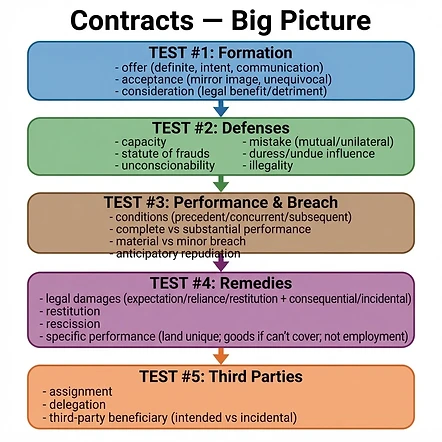
A contract requires an offer, acceptance, and consideration. An Offer is a manifestation of willingness to enter into a bargain that justifies another person in understanding that their assent is invited. It must have definite terms. Acceptance is the manifestation of assent to the terms of the offer in a manner invited or required. Under the Mirror Image Rule, common law requires that the acceptance match the offer exactly; otherwise, it is a counteroffer.
Consideration and Substitutes
Consideration is a bargained-for exchange of legal value. A promise to perform a pre-existing legal duty is not consideration, known as the Pre-existing Duty Rule. However, modifications for the sale of goods under the Uniform Commercial Code (UCC) do not require new consideration if made in good faith. Promissory estoppel acts as a substitute for consideration when a party reasonably and foreseeably relies on a promise to their detriment.
Statute of Frauds and Parol Evidence Rule
The Statute of Frauds requires certain contracts, such as those for the sale of land, goods over $500, or services taking longer than one year, to be in writing and signed by the party to be charged. The Parol Evidence Rule prevents parties from introducing evidence of prior or contemporaneous oral agreements that contradict or supplement the final written contract, unless the contract is ambiguous or the evidence is needed to prove fraud or mistake.
Performance and Breach
Contractual duties are discharged by performance or excuse. A Material Breach allows the non-breaching party to suspend performance and sue for damages. A Minor Breach requires the non-breaching party to perform but allows them to deduct the cost of the deficiency. Anticipatory repudiation occurs when a party unequivocally indicates that they will not perform, allowing the other party to treat the contract as breached immediately.
Defenses to Formation
Contracts may be void or voidable due to defects in formation. Mistake (mutual or unilateral), Duress, Undue Influence, and Fraud/Misrepresentation can negate mutual assent. If a contract involves an illegal subject matter, it is generally void as a matter of public policy. Capacity, such as infancy or mental infirmity, may also render a contract voidable by the party lacking capacity.
Third Party Beneficiaries and Assignment
Third-party beneficiaries are intended beneficiaries who can enforce a contract once their rights vest. An Assignment is the transfer of rights under a contract, while a Delegation is the transfer of duties. Most rights are assignable unless the assignment materially changes the duty of the obligor or is prohibited by law or contract. Delegation does not relieve the delegator of liability unless there is a novation.
Damages and Remedies
The goal of contract damages is to place the non-breaching party in the position they would have been in had the contract been performed. Expectation Damages are the standard measure. Parties have a duty to mitigate their damages after a breach. Liquidated damages clauses are enforceable if they are a reasonable forecast of damages and not a penalty. Specific performance is an equitable remedy available only when money damages are inadequate, such as for the sale of real estate.