Elements, Defenses, and Crimes
Elements, Defenses, and Crimes
Legal treatise · Criminal Law
Elements of a Crime
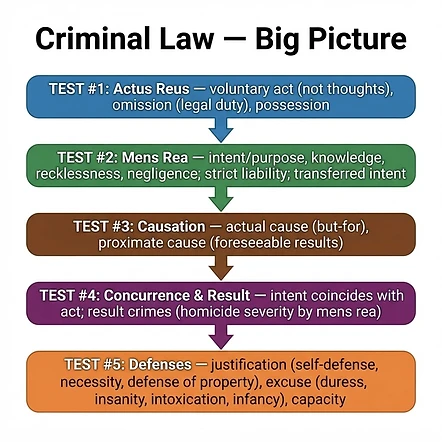
Criminal liability requires both an Actus Reus (a voluntary act or omission) and a Mens Rea (a guilty mind). Mens rea categories include specific intent, general intent, recklessness, and negligence. Under the Model Penal Code, one acts with purpose, knowledge, recklessness, or negligence. Strict liability crimes require no proof of mens rea, focusing solely on the commission of the act itself.
Homicide and Homicide Degrees
Homicide is the killing of a human being by another. Murder is the unlawful killing of a human being with malice aforethought. Malice includes intent to kill, intent to commit a dangerous felony, or extreme recklessness (depraved heart). First-degree murder typically requires premeditation and deliberation. Voluntary manslaughter occurs during the heat of passion caused by adequate provocation, while involuntary manslaughter involves unintended killings during criminal negligence or misdemeanor commissions.
Theft and Property Crimes
Property crimes focus on the unauthorized taking or destruction of property. Larceny is the trespassory taking and carrying away of the personal property of another with the intent to permanently deprive. Embezzlement involves the fraudulent conversion of property by one in lawful possession. Robbery is larceny from the person by force or threat of force, and Burglary is the breaking and entering of a dwelling at night with the intent to commit a felony therein.
Inchoate Offenses
Attempt requires a specific intent to commit a crime and an overt act beyond mere preparation. Solicitation is asking someone to commit a crime with the intent that they do so. Conspiracy requires an agreement between two or more persons to commit a crime and an overt act in furtherance of the agreement. Under the Pinkerton doctrine, conspirators are liable for crimes of co-conspirators if they are foreseeable and in furtherance of the conspiracy.
Defenses: Justification and Excuse
Defenses include justification and excuse. Self-Defense permits the use of proportional force to prevent an immediate threat of unlawful harm. The Insanity Defense (e.g., M'Naghten rule) tests whether the defendant understood the nature of their act or that it was wrong. Duress is a defense if the defendant committed the crime under threat of imminent death or serious bodily injury, provided the crime is not intentional murder.
Constitutional Protections in Criminal Procedure
The Fourth Amendment protects against unreasonable searches and seizures, requiring probable cause for warrants. The Exclusionary Rule prevents the use of evidence obtained in violation of these rights. The Fifth Amendment grants the right against self-incrimination, necessitating the Miranda warnings during custodial interrogations. The Sixth Amendment guarantees the right to counsel at all critical stages of a criminal prosecution.
Criminal Law: Added Rules and Exam Tips
General Principles
- Jurisdiction exists where any element occurred, where a result occurred, or for conspiracy and attempt tied to the state. Federal crimes are statutory; ex post facto laws and bills of attainder are barred; criminal statutes are strictly construed and must give fair warning.
- Merger: modern law does not merge felonies and misdemeanors, but solicitation and attempt merge into the completed crime; conspiracy does not.
Elements and Mental States
- Act must be voluntary. Omissions count only with a legal duty (statute, contract, relationship, voluntary assumption of care, or creating the peril), knowledge of the facts, and the ability to act. No general duty to rescue.
- Possession requires awareness of control for enough time to end it.
- Common-law mental states: specific intent (solicitation, attempt, conspiracy, premeditated murder, larceny, robbery, burglary, forgery, false pretenses, embezzlement), malice (common-law murder, arson), general intent, and strict liability (statutory rape, selling liquor to minors).
- MPC states: purposely, knowingly, recklessly (conscious disregard of a substantial and unjustifiable risk), negligently (failure to perceive a risk that is a substantial deviation). Unless a statute says otherwise, at least recklessness is required.
- Transferred intent applies to homicide, battery, and arson but not to attempt. Concurrence of intent and act is required. Corporations can be criminally liable through agents acting within the scope of employment.
Accomplice Liability
- Requires intent to help the crime, not mere knowledge, though a stake in the venture can supply intent. Liable for the target crime and other foreseeable crimes in furtherance. Withdrawal needs timely repudiation, plus neutralizing any assistance already given. Accessory after the fact is a separate, lesser offense.
Inchoate Crimes
- Solicitation: asking another to commit a crime with intent; no agreement needed; merges. Conspiracy: agreement plus intent to agree and to achieve the goal, and an overt act in most states; Wharton's Rule; unilateral approach under the MPC; liability for foreseeable co-conspirator crimes; withdrawal does not defeat conspiracy itself; chain versus hub-and-spoke.
- Attempt: specific intent plus an act beyond mere preparation (proximity or substantial-step test). Factual impossibility is no defense; legal impossibility is. MPC recognizes voluntary and complete abandonment.
Capacity Defenses
- Insanity tests: M'Naghten (does not know right from wrong or the nature of the act), irresistible impulse, Durham (product of illness), MPC (lacks substantial capacity to appreciate criminality or conform conduct). Competency to stand trial is a separate trial-stage issue.
- Voluntary intoxication negates only specific intent; involuntary intoxication is treated like insanity. Infancy: under 7 no liability, 7 to 14 rebuttable presumption, over 14 adult (modern statutes set minimum ages).
Justification and Excuse
- Self-defense: reasonable, imminent threat; deadly force only against death or serious bodily harm; no duty to retreat in most states; an aggressor regains the right only after withdrawing or if the victim escalates. Imperfect self-defense reduces murder to manslaughter in some states.
- Defense of others (reasonable belief the person may use force), dwelling (deadly force only to prevent a violent entry or a felony), and property (never deadly force). Crime prevention and arrest allow deadly force only against dangerous felons; resisting an improper arrest allows nondeadly force.
- Necessity: choice of lesser evil, never for killing; natural forces. Duress: threat of imminent death or serious harm; not a defense to homicide.
- Mistake of fact helps only if it negates a required mental state (reasonable mistake needed except for specific intent). Mistake of law is generally no defense. Consent applies only if lack of consent is an element or for minor batteries. Entrapment needs government origin of the plan and no predisposition.
Offenses Against the Person
- Battery: unlawful application of force causing injury or offensive touching. Assault: attempted battery or intentionally creating reasonable apprehension of imminent harm.
- Homicide: murder is killing with malice (intent to kill, intent to inflict serious bodily injury, depraved-heart indifference, or felony murder). Voluntary manslaughter requires adequate provocation, actual provocation, no time to cool, and no actual cooling. Involuntary manslaughter involves criminal negligence or an unlawful act. First-degree murder needs premeditation or a statutory category (felony murder for burglary, arson, rape, robbery, kidnapping).
- Felony murder limits: the felony must be independent of the killing (no merger), death must be foreseeable, and it must occur before the felons reach safety; co-felon deaths caused by victims or police fall outside the agency theory.
- Causation: but-for cause plus proximate cause; intervening acts break the chain only if unforeseeable (negligent medical care is foreseeable). The year-and-a-day rule is mostly abolished.
- False imprisonment (unlawful confinement) and kidnapping (confinement plus movement or concealment). Rape: nonconsensual intercourse by force, threat, incapacity, or fraud about the nature of the act; statutory rape is strict liability, so a reasonable mistake of age is no defense.
Property Offenses
- Larceny: trespassory taking and carrying away of another's personal property with intent to permanently deprive at the time of taking. Embezzlement: fraudulent conversion by someone in lawful possession. False pretenses: obtaining title by a false statement of existing fact. Robbery: taking from the person or presence by force or threat. Extortion: threats of future harm. Receiving stolen property needs knowledge. Forgery: making or altering a writing with legal significance so that it is false, with intent to defraud. Larceny by trick passes possession; false pretenses passes title.
- Burglary (common law): breaking and entering a dwelling of another at night with intent to commit a felony, with the intent present at entry. Arson: malicious burning (charring suffices) of a structure. Malicious mischief: malicious damage to another's property.
Judicial-Procedure Offenses
- Perjury (intentional material false oath), subornation, bribery, compounding, and misprision (usually requires active concealment today).