Relevance, Hearsay, and Witness Testimony
Relevance, Hearsay, and Witness Testimony
Legal treatise · Evidence
Relevance and Admissibility
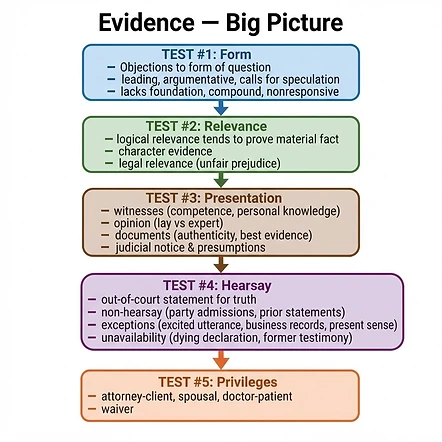
Evidence must be relevant to be admissible. Evidence is Relevant if it has any tendency to make a fact of consequence more or less probable. Under Rule 403, a judge may exclude relevant evidence if its probative value is substantially outweighed by the danger of unfair prejudice, confusion of the issues, or waste of time. Character evidence is generally inadmissible to prove conduct in conformity therewith in civil cases, but is admissible in criminal cases if the defendant opens the door.
Hearsay and Its Exceptions
Hearsay is an out-of-court statement offered to prove the truth of the matter asserted. It is generally inadmissible unless it falls under an exclusion or exception. Key exclusions include statements by an opposing party (admissions) and certain prior statements by witnesses. Exceptions include Present Sense Impressions, Excited Utterances, Statements for Medical Diagnosis, and Business Records. The unavailability of the declarant is required for exceptions such as statements against interest.
Witness Testimony and Impeachment
Witnesses are generally competent if they have personal knowledge and take an oath. A witness can be impeached through evidence of prior inconsistent statements, bias, or criminal convictions. Prior Inconsistent Statements are generally admissible for impeachment, but not as substantive evidence unless made under oath at a prior proceeding. A witness's credibility may be rehabilitated after it has been attacked.
Authentication and Best Evidence Rule
To be admissible, physical evidence must be authenticated, meaning there is sufficient evidence to support a finding that the item is what the proponent claims it to be. The Best Evidence Rule requires that the original document, recording, or photograph be produced to prove its content, unless the original is lost, destroyed, or otherwise unavailable, allowing for secondary evidence like oral testimony or copies.
Privileges and Policies
Privileges protect communications from disclosure in court. Common privileges include Attorney-Client, Physician-Patient (in some jurisdictions), and Spousal Privilege. These protect confidential communications made for the purpose of seeking or providing legal or medical advice. Policy-based exclusions also exist, such as the prohibition on admitting evidence of subsequent remedial measures to prove negligence or liability.
Master Outline Add-On: Evidence
- Relevance and prejudice. Evidence is relevant if it changes the probability of a consequential fact; Rule 403 allows exclusion when specified risks substantially outweigh probative value. Exam cue: Unfair prejudice is not the same as damaging evidence.
- Character. Propensity use is limited; criminal-defendant exceptions and non-propensity other-act uses may apply. Exam cue: State the permissible purpose and limiting instruction.
- Authentication and originals. The proponent needs evidence that the item is what it is claimed to be; the original-writing rule applies to proving contents. Exam cue: Do not confuse authentication with hearsay.
- Impeachment. Bias, perception, inconsistency, convictions, and certain dishonest acts may be used, with limits. Exam cue: Watch the extrinsic-evidence restrictions.
- Hearsay. An out-of-court statement offered for its truth is excluded unless defined out or excepted; treat every layer. Exam cue: Identify declarant, statement, purpose, and exception.
- Exceptions. Present sense impression, excited utterance, business records, medical treatment, state of mind, and unavailable-declarant exceptions each have specific predicates. Exam cue: Business records need a solid foundation.
- Confrontation. In criminal cases, testimonial statements against the accused may be barred absent unavailability and a prior chance to cross-examine. Exam cue: This is separate from hearsay exceptions.
- Privileges. Attorney-client, spousal, and psychotherapist privileges protect specified confidential communications or relationships. Exam cue: Identify holder, waiver, and exceptions.
- Experts. Experts need qualification, sufficient basis, reliable methods, and reliable application under current Rule 702. Exam cue: Differentiate lay opinion from expert testimony.
Self-test: For each topic above, recite the elements, name one exception, and write a two-sentence fact application.
Essay checklist: parties and claims; governing authority; elements; exceptions and defenses; burden; remedy; strongest opposing argument.