
Estates, Concurrent Ownership, and Land Use
Estates, Concurrent Ownership, and Land Use
Legal treatise · Real Property
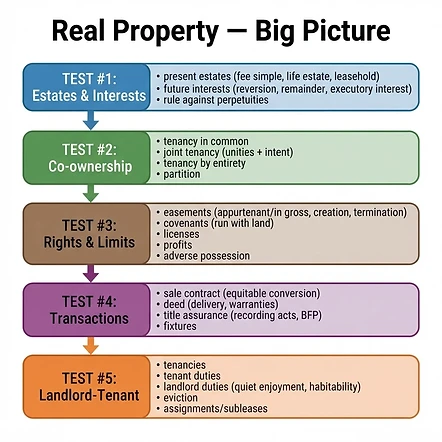
Estates in Land
Real property law classifies interests in land into various estates. The Fee Simple Absolute is the highest form of ownership. A Fee Simple Determinable automatically terminates upon the occurrence of a stated event, returning the interest to the grantor via a Possibility of Reverter. A Fee Simple Subject to Condition Subsequent allows the grantor to reclaim the land via a Right of Entry if a condition is violated. Remainders and executory interests are future interests that follow a life estate or fee interest.
Concurrent Ownership
Concurrent ownership includes Tenancy in Common, where owners hold distinct, fractional interests that are inheritable, and Joint Tenancy, which includes the right of survivorship. A joint tenancy requires the four unities: time, title, interest, and possession. If any of these unities are severed, the joint tenancy converts to a tenancy in common. A Tenancy by the Entirety is similar to a joint tenancy but exists only between married couples and provides protections against individual creditor claims.
Landlord-Tenant Law
Landlord-tenant relationships create a leasehold estate. The Implied Warranty of Habitability requires residential landlords to maintain the premises in a condition fit for human habitation. A tenant has a duty to pay rent and not commit waste. If a landlord breaches the covenant of quiet enjoyment through a constructive eviction, the tenant may terminate the lease and stop paying rent. Assignments and subleases are distinguished by whether the tenant transfers their entire remaining interest.
Easements, Covenants, and Servitudes
An Easement is a non-possessory right to use another’s land. Easements can be created by express grant, prescription, implication, or necessity. Covenants (real covenants and equitable servitudes) are written promises to do or not do something on land. They run with the land if they meet requirements such as intent, touch and concern, and notice. Equitable servitudes are enforceable through injunctions regardless of whether they meet all technical requirements of real covenants.
Transfer of Title and Recording Acts
Real estate is transferred by deed, which must be signed and delivered. Recording Acts protect bona fide purchasers from prior, unrecorded interests. Notice Statutes protect subsequent purchasers who take without notice of a prior interest. Race-Notice Statutes protect those who take without notice and record first. A Warranty Deed provides specific covenants of title, such as the covenant of seisin and the covenant against encumbrances, ensuring the grantor has valid title to convey.
Property Exam Traps and Worked Hypotheticals
How to Label a Conveyance
- Identify the present estate first, based on the words of limitation.
- Then identify who holds the future interest: the grantor (reversionary), a person who takes after a natural end of the prior estate (remainder), or anyone else (executory interest).
- Classify remainders as vested or contingent. A remainder is contingent if the taker is unascertained or a condition precedent must be met other than the end of the prior estate.
- Apply the Rule Against Perpetuities only to interests that are not certain to vest within the period.
Traps
- "To A for life, then to B if B survives A" gives B a contingent remainder, because survival is a condition precedent. The reversion in the grantor lasts until B's interest vests.
- A class gift fails under the Rule Against Perpetuities if even one possible member could be added too late. The "fertile octogenarian" presumption means a person is assumed able to have children at any age.
- Joint tenants cannot give away a share by will; a joint tenant's sale of her share severs only her share, leaving the rest in joint tenancy.
- A sublease does not create privity of estate, so the landlord cannot sue a subtenant directly for rent.
- A tenant who stays in the premises after serious habitability problems cannot claim constructive eviction.
- Oral land-sale contracts are unenforceable, but part performance (payment plus possession or improvements) can take the case outside the Statute of Frauds.
- Race-notice jurisdictions protect a later buyer only if she records before the earlier buyer does.
- Adverse possession requires use without permission; a permissive user becomes hostile only by clearly repudiating the owner's permission.
Worked Hypotheticals
1. Fee simple determinable. O conveys to the town "for so long as the land is used as a park." Result: town has a fee simple determinable; O has a possibility of reverter. If the park use stops, title returns to O automatically, without any action.
2. Rule Against Perpetuities. O conveys "to my grandchildren who reach age 25." O has one living child, who has no children. Result: void. A grandchild could be born after all lives in being die and reach 25 more than 21 years later.
3. Recording. O sells Blackacre to A, who does not record. O later sells to B, who pays value and has no notice. Result: in notice and race-notice states B prevails if B has no notice; in a race-notice state B must also record before A does.
4. Easement by implication. O owns two lots, with a driveway crossing Lot 2 that serves Lot 1 and is plainly visible. O sells Lot 1 without mentioning the driveway. Result: an implied easement from prior use is likely, because the use was apparent, continuous, and reasonably necessary.
Master Outline Add-On: Real Property
- Estates and future interests. Fee simple, defeasible fees, life estates, remainders, and executory interests set present possession and future ownership. Exam cue: Classify from the exact conveyance language.
- Concurrent ownership. Tenancy in common has no survivorship; joint tenancy does, subject to severance; tenancy by the entirety exists in some states. Exam cue: Analyze creation, severance, and partition.
- Landlord-tenant. Leasehold estates, habitability, constructive eviction, assignment, and sublease drive rights and liability. Exam cue: Privity of estate differs from privity of contract.
- Servitudes. Easements, covenants, and equitable servitudes create use rights or restrictions; creation, notice, running, and termination matter. Exam cue: Distinguish damages from injunctive remedies.
- Adverse possession. Actual, open and notorious, exclusive, hostile, continuous possession for the statutory period can ripen into title. Exam cue: Tacking and disabilities can change the result.
- Conveyancing. Land contracts face the statute of frauds and marketable-title duties; deeds need delivery and adequate description. Exam cue: Address equitable conversion and risk of loss.
- Recording. Notice, race, and race-notice statutes set priority among qualifying purchasers; inquiry and record notice matter. Exam cue: Apply the exact statute type.
- Mortgages. Foreclosure affects interests by priority; purchase-money status, recording, and assumption change outcomes. Exam cue: Identify senior and junior liens and any deficiency.
- Land use. Zoning and nonconforming-use rules restrict use; variances require statutory grounds. Exam cue: Distinguish zoning from private covenants.
Self-test: For each topic above, recite the elements, name one exception, and write a two-sentence fact application.
Essay checklist: parties and claims; governing authority; elements; exceptions and defenses; burden; remedy; strongest opposing argument.