
Negligence, Intentional Torts, and Strict Liability
Negligence, Intentional Torts, and Strict Liability
Legal treatise · Torts
Intentional Torts
Intentional torts require an act, intent, and causation. Battery is the intentional causing of harmful or offensive contact. Assault is the intentional creation of a reasonable apprehension of imminent harmful or offensive contact. False Imprisonment requires the unlawful confinement of a person against their will. Trespass to Land involves physical invasion of property. Defenses include consent, self-defense, and necessity, which may be public or private.
Negligence: Duty and Breach
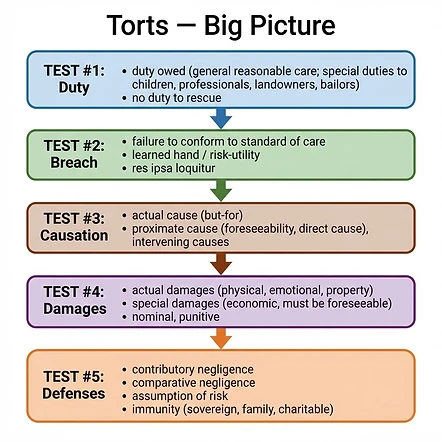
Negligence requires duty, breach, causation, and damages. The Duty of Care is to act as a reasonably prudent person under the circumstances. Special duties exist for professionals (standard of the ordinary member of the profession), landowners (duties to invitees, licensees, and trespassers), and common carriers. A Breach occurs when the defendant's conduct falls below this standard. The doctrine of Res Ipsa Loquitur allows a jury to infer negligence if the accident is of a type that would not occur without negligence.
Causation and Damages
Causation consists of Actual Cause (the "but-for" test) and Proximate Cause (foreseeability). Proximate cause limits liability to risks that were reasonably foreseeable. The defendant takes the plaintiff as they find them under the Eggshell Skull Rule, meaning they are liable for the full extent of the damages even if the plaintiff had a pre-existing vulnerability. Damages must be proved and cannot be speculative, usually encompassing medical costs, lost wages, and pain and suffering.
Strict Liability and Products Liability
Strict Liability applies to abnormally dangerous activities and the keeping of wild animals. The defendant is liable regardless of fault. Products Liability can be based on negligence, warranty, or strict liability. A strict products liability claim requires showing the product was defective (manufacturing, design, or warning) and that the defect existed when the product left the defendant's control. The defendant must be a commercial supplier of the product.
Defamation and Privacy Torts
Defamation involves a defamatory statement concerning the plaintiff, published to a third party, causing damage to reputation. Public figures must prove Actual Malice, meaning the defendant acted with knowledge of falsity or reckless disregard for the truth. Privacy torts include Intrusion upon Seclusion, False Light, Public Disclosure of Private Facts, and Appropriation of Likeness. These protect individuals from unwarranted interference with their personal lives.