
Jurisdiction, Pleadings, and Preclusion
Jurisdiction, Pleadings, and Preclusion
Legal treatise · Civil Procedure
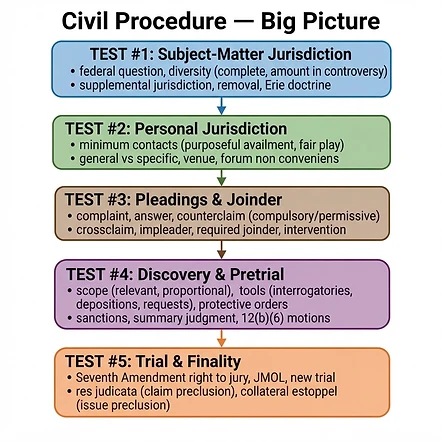
Personal and Subject Matter Jurisdiction
Subject Matter Jurisdiction requires a federal question or diversity of citizenship (amount in controversy exceeding $75,000 and complete diversity). Personal Jurisdiction requires that the defendant has sufficient minimum contacts with the forum state such that the suit does not offend traditional notions of fair play and substantial justice. Jurisdiction can be general (all claims) or specific (claims related to the contact).
Venue and Service of Process
Venue is proper in a district where any defendant resides if all reside in the same state, or where a substantial part of the events giving rise to the claim occurred. Service of Process must be reasonably calculated to provide notice to the defendant and generally requires delivering a summons and a copy of the complaint according to the Federal Rules of Civil Procedure. Failure to properly serve can lead to dismissal of the action.
Pleadings and Joinder
The Complaint must contain a short and plain statement of the claim showing the pleader is entitled to relief, meeting the plausibility standard. Defendants must respond with an Answer or a motion to dismiss. Joinder rules are liberal, allowing for permissive and compulsory joinder of parties and claims. A Cross-claim is against a co-party, and an Impleader allows a defendant to bring in a third party who may be liable for the claim.
Discovery and Pretrial Motions
Discovery allows parties to obtain information through depositions, interrogatories, and requests for production. The scope of discovery covers any non-privileged matter relevant to the claim or defense and proportional to the needs of the case. Summary Judgment is granted if there is no genuine dispute of material fact and the moving party is entitled to judgment as a matter of law. Judges do not weigh evidence but determine if a trial is necessary.
Res Judicata and Collateral Estoppel
Res Judicata (Claim Preclusion) prevents a party from re-litigating a claim that was or could have been brought in a previous final judgment on the merits. Collateral Estoppel (Issue Preclusion) prevents re-litigation of a specific issue of fact or law that was actually litigated and essential to a prior final judgment. These doctrines promote judicial efficiency and prevent inconsistent results.
Federal Jurisdiction and Procedure: Added Rules
- Subject-matter jurisdiction cannot be waived and may be raised at any time. Federal question: a federal claim must appear in the well-pleaded complaint, not in a defense. Diversity: complete diversity at filing, amount over $75,000 (claims by one plaintiff against one defendant may be aggregated), domicile means presence plus intent to remain, corporations are citizens of the state of incorporation and principal place of business.
- Supplemental jurisdiction covers claims sharing a common nucleus of operative fact; a plaintiff cannot use it to defeat the diversity requirement.
- Personal jurisdiction: long-arm statute plus due process (minimum contacts, purposeful availment, foreseeability, fair play and substantial justice). General jurisdiction needs substantial, continuous ties; specific jurisdiction requires the claim to arise from forum contacts. A quasi in rem judgment is limited to the value of the attached property.
- Venue (federal): district where a defendant resides, where a substantial part of the events occurred, or any district with personal jurisdiction as a fallback. Improper venue is waived if not raised; a convenient-forum transfer under section 1404 keeps the original state's law, unlike forum non conveniens, which dismisses.
- Removal: defendant may remove cases that could have been filed in federal court, not diversity cases where a defendant is a citizen of the forum; file within 30 days of the first removable document.
- Joinder: counterclaims (compulsory if same transaction), cross-claims (same transaction, never compulsory), impleader of a third party who may owe indemnity or contribution (as of right within 14 days after answering), intervention (of right if interests would be impaired, or permissive with a common question), interpleader (rule or statutory).
- Section 1983 gives damages against state actors in their personal capacity and injunctions against officials in their official capacity; the Eleventh Amendment bars damages suits against states, and Ex parte Young allows prospective relief against officers.
- Abstention: Pullman (unclear state law may moot the constitutional question), Burford (complex state regulatory scheme), Younger (pending state proceedings).
- Discovery: relevant, non-privileged information reasonably calculated to lead to admissible evidence. Tools: initial disclosures, depositions, interrogatories, requests for production, and requests for admission. Work product is protected unless substantial need and undue hardship are shown. A signature on a discovery request certifies it is warranted and not for an improper purpose.
- Summary judgment (Rule 56): no genuine dispute of material fact and entitlement to judgment as a matter of law, with evidence viewed for the non-movant. Judgment as a matter of law is available once the opponent is fully heard.
- Preclusion: claim preclusion needs the same parties, a final merits judgment, and the same claim; issue preclusion needs an actually litigated and essential issue and a party against whom it is asserted who was in the first case (mutuality is not required everywhere).
Master Outline Add-On: Civil Procedure
- Federal question. Original jurisdiction covers claims arising under federal law as shown on the well-pleaded complaint. Exam cue: An anticipated federal defense does not create jurisdiction.
- Diversity. Complete diversity plus an amount in controversy above $75,000 under 28 U.S.C. 1332. Exam cue: Citizenship is domicile; corporations have two citizenships.
- Supplemental jurisdiction. Claims sharing a common nucleus of operative fact may qualify, subject to diversity-case restrictions on plaintiffs and discretion to decline. Exam cue: Establish original jurisdiction first.
- Personal jurisdiction. Needs statutory authorization and due process; general jurisdiction exists where the defendant is at home, specific jurisdiction needs purposeful contacts related to the claim. Exam cue: Distinguish consent, waiver, general, and specific jurisdiction.
- Venue and removal. Venue turns on defendant residence and where events occurred; defendants may remove if original jurisdiction exists, within procedural limits. Exam cue: Check the forum-defendant rule and timing.
- Erie. A federal diversity court applies state substantive law and federal procedural law, including valid federal rules. Exam cue: Ask first whether a federal rule directly governs.
- Pleadings and joinder. Rule 8 requires a plausible short, plain claim; Rules 12, 13, 14, 19, 20 and 24 govern defenses, claims, and parties. Exam cue: Check waiver and compulsory counterclaims.
- Discovery. Reaches nonprivileged, relevant, proportional information; sanctions and protective orders are available. Exam cue: Separate attorney-client privilege from work product.
- Dispositive motions. Rule 12(b)(6) tests pleading sufficiency; summary judgment requires no genuine dispute of material fact and entitlement to judgment as a matter of law. Exam cue: Never weigh credibility on summary judgment.
- Preclusion and appeal. Claim preclusion bars relitigating a claim after a valid final judgment; issue preclusion covers issues actually litigated and essential to the judgment. Exam cue: Check parties, finality, opportunity to litigate, and appealability.
Self-test: For each topic above, recite the elements, name one exception, and write a two-sentence fact application.
Essay checklist: parties and claims; governing authority; elements; exceptions and defenses; burden; remedy; strongest opposing argument.