
Torts
Torts — Treatise (MBE)
Torts — Treatise (MBE)
Legal treatise · Torts
Torts MBE Treatise: VerdictUp Study Guide
I. Intentional Torts
General requirements: Act (volitional movement), Intent (specific: purpose to cause result; general: substantial certainty of result), and Causation (substantial factor). Transferred Intent applies only to Battery, Assault, False Imprisonment, Trespass to Land, and Trespass to Chattels.
Core Torts
- Battery: Harmful/offensive contact with P’s person. Tip: Offensive means unpermitted by reasonable sense of dignity.
- Assault: Act creating reasonable apprehension of immediate harmful/offensive contact. Tip: Mere words are rarely sufficient without overt action.
- False Imprisonment: Confinement of P in bounded area without reasonable means of escape. Tip: Moral pressure is not confinement; physical barriers or threats are required.
- IIED: Extreme/outrageous conduct causing severe emotional distress. Tip: Requires more than mere insults; needs conduct exceeding all bounds of decency.
Property Torts
- Trespass to Land: Physical invasion of P’s land. Tip: Intent to enter is enough, even if D mistakenly believes land is theirs.
- Trespass to Chattels: Minor interference with P’s possessory interest. Tip: Requires actual damage or dispossession.
- Conversion: Intentional interference so serious it justifies forced sale. Tip: Measure damages by the full fair market value at the time of conversion.
Defenses
- Necessity: Public necessity is an absolute defense; Private necessity allows entry but D must pay for damages. Tip: Private necessity is an incomplete privilege.
- Self-Defense/Defense of Others: Reasonable belief of immediate danger. Tip: No duty to retreat unless in a minority jurisdiction.
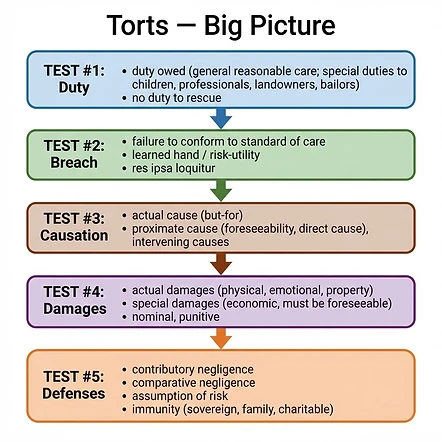
II. Negligence
Negligence accounts for roughly 50% of MBE questions.
Elements
- Duty: Foreseeable plaintiffs (see Palsgraf v. Long Island Railroad Co.). Standard: Reasonably prudent person (RPP).
- Breach: Failure to meet standard of care. Use res ipsa loquitur where the accident speaks for itself.
- Causation: Actual (but-for) and Proximate (foreseeability). Tip: Intervening acts that are foreseeable do not break the chain of causation.
- Damages: Actual loss required.
Special Standards
- Negligence Per Se: Statutory violation establishes duty and breach if P is in the protected class and the harm is the type the statute aimed to prevent.
- Land Occupier: Trespassers (no duty to unknown, warn of known man-made traps for anticipated), Licensees (warn of known dangers), Invitees (inspect and make safe). See Rowland v. Christian for the shift toward unified standards.
- NIED: Zone of danger or bystander test (Dillon v. Legg).
III. Strict Liability & Products Liability
Strict Liability
- Wild Animals: Strict liability for all injuries.
- Abnormally Dangerous Activities: Factors include high risk and inability to eliminate risk with care. Tip: Liability is limited to the harm caused by the dangerous aspect.
Products Liability
- Negligence: Manufacturers/suppliers liable for design or manufacturing flaws. See MacPherson v. Buick Motor Co.
- Strict Liability in Tort: Focus on the product, not the defendant's conduct. Requires (1) commercial supplier, (2) defective product (manufacturing, design, or warning), (3) causation, (4) damages. Tip: A "learned intermediary" defense applies to prescription drugs.
IV. Other Torts
- Defamation: Statement of fact, publication, falsity, fault. Public figures must prove actual malice (New York Times Co. v. Sullivan). Tip: Libel (written) allows general damages; slander (spoken) often requires proof of special damages.
- Invasion of Privacy: Intrusion on seclusion, false light, appropriation, disclosure of private facts. Tip: Truth is generally not a defense to disclosure of private facts.
- Nuisance: Private (substantial, unreasonable interference with use/enjoyment of land) vs. Public (act unreasonable interfering with health/safety of community).
V. General Considerations
- Vicarious Liability: Respondeat superior for employees acting in scope of employment. Independent contractors generally do not trigger liability unless non-delegable duty or apparent agency exists.
- Joint & Several Liability: Any tortfeasor can be held liable for the entire damage amount. Tip: Contribution allows a D who paid more than their share to seek reimbursement.
- Survival/Wrongful Death: Survival actions belong to the decedent’s estate; wrongful death belongs to the family for their losses.
Rapid Review
- Transferred intent applies only to the five original trespassory torts.
- Battery needs contact; Assault needs apprehension.
- Landlord is liable for known, non-obvious dangers to licensees.
- Res ipsa loquitur shifts the burden of production, not persuasion.
- Products liability: Misuse is a defense if it is unforeseeable.
- Actual malice means knowledge of falsity or reckless disregard.
- Comparative negligence reduces recovery; contributory negligence bars it.
- Public necessity is a total defense; private is qualified.
- Independent contractors: No liability for the employer unless the work is inherently dangerous.
- Negligence per se is a rule of law, not just evidence.
- Assumption of risk can be express or implied.
- Survival actions preserve claims that existed during the victim's life.
Master Outline Add-On: Torts
- Intentional torts. Battery needs intent to cause harmful or offensive contact and contact; assault needs reasonable apprehension of imminent contact. Exam cue: Intent to contact is not intent to injure.
- Other intentional torts. False imprisonment, trespass, conversion, and IIED have distinct elements and defenses. Exam cue: Discuss consent and privilege.
- Negligence. Duty, breach, actual and proximate cause, and damages. Exam cue: Organize by element, not chronology.
- Standards of care. The reasonable-person standard is modified for professionals, children, land possessors, and statutory violations. Exam cue: Negligence per se does not automatically prove causation.
- Proof and causation. Res ipsa permits an inference in qualifying cases; but-for and substantial-factor tests address factual cause. Exam cue: Distinguish foreseeable intervening causes from superseding ones.
- Defenses. Comparative or contributory fault and assumption of risk can reduce or bar recovery. Exam cue: State the jurisdiction's fault system if given.
- Vicarious liability. Employers answer for employees acting in scope; special and nondelegable duties can reach contractors. Exam cue: Also look for the employer's own negligence.
- Products liability. Manufacturing defects, design defects, and inadequate warnings support strict liability, alongside negligence and warranty. Exam cue: Separate defect, causation, and defenses.
- Defamation and privacy. Defamation needs a false defamatory statement of fact, publication, fault, and injury, with constitutional limits for public figures and public concern. Exam cue: Analyze actual malice where it applies.
Self-test: For each topic above, recite the elements, name one exception, and write a two-sentence fact application.
Essay checklist: parties and claims; governing authority; elements; exceptions and defenses; burden; remedy; strongest opposing argument.