
Contracts — Treatise (MBE/UCC)
Contracts — Treatise (MBE/UCC)
Legal treatise · Contracts
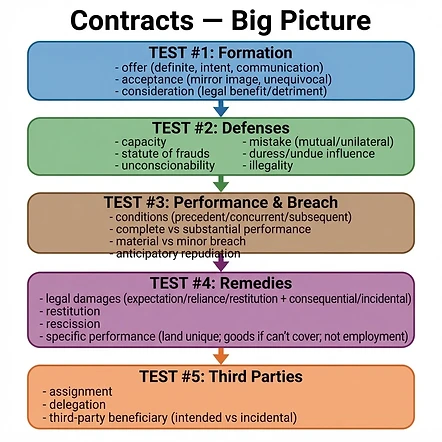
VerdictUp Bar Prep: Contracts Mastery for the MBE
I. Common Law or UCC
Goods vs. Services
- Goods: All things movable at the time of identification to the contract. (UCC 2-105).
- Services/Real Estate: Governed by Common Law.
- Mixed Transactions: Use the Predominant Purpose Test. Ask: Does the contract involve primarily goods or services? If goods, use UCC; if services, use Common Law.
- Exam Tip: If the price of goods is a small fraction of the total price, it is likely a service contract.
II. Formation
Offer
- Elements: Manifestation of willingness to enter a bargain so that the other party understands assent is invited.
- UCC Offers: Open price terms are permitted if the parties intended to contract (UCC 2-305). Firm Offers (UCC 2-205): An offer by a merchant signed in writing that promises to keep an offer open is irrevocable for a reasonable time (max 3 months) without consideration.
- Exam Tip: Advertisements are generally invitations to deal, not offers, unless they contain specific words of commitment (e.g., Carlill v. Carbolic Smoke Ball).
Acceptance
- Termination: Death, incapacity, lapse of time, rejection, or revocation (must be received prior to acceptance).
- UCC 2-207 (Battle of the Forms): Additional terms in an acceptance do not invalidate it. Between merchants, these terms become part of the contract unless they materially alter it, the offer expressly limits acceptance, or the offeror objects.
- Exam Tip: A counteroffer terminates the power of acceptance; a mere inquiry does not.
Consideration
- Bargained-for Exchange: A performance or return promise must be sought by the promisor and given by the promisee.
- Sufficiency: Courts generally do not inquire into adequacy (Peppercorn Rule).
- Alternatives: Promissory Estoppel (detrimental reliance) may enforce a promise without consideration.
- Exam Tip: A promise to perform a pre-existing legal duty is not valid consideration.
Modifications
- Common Law: Needs new consideration.
- UCC 2-209: No consideration needed for a modification made in good faith.
- Exam Tip: Under UCC, always mention the "good faith" requirement for modifications.
III. Contract Defenses
- Statute of Frauds (UCC 2-201): Contracts for the sale of goods $500+ must be in writing. Exceptions: Specially manufactured goods, judicial admission, or part performance.
- Mistake: Mutual mistake allows rescission if the mistake goes to a basic assumption. Unilateral mistake requires the non-mistaken party to know of the error (e.g., Raffles v. Wichelhaus).
- Duress/Undue Influence: Physical or economic coercion renders a contract voidable.
- Exam Tip: Misrepresentation must be material and relied upon.
IV. Content & Meaning
- Parol Evidence Rule (PER): Prevents extrinsic evidence of prior/contemporaneous agreements that contradict a final written integration. Does not bar evidence of conditions precedent or side agreements that naturally would have been separate.
- Warranties: Implied Warranty of Merchantability (goods must be fit for ordinary purposes, UCC 2-314); Implied Warranty of Fitness for a Particular Purpose (UCC 2-315).
- Exam Tip: PER only applies to agreements made before or at the time of the final writing.
V. Performance, Breach & Discharge
- UCC Perfect Tender Rule (2-601): The seller must deliver goods exactly conforming to the contract. If not, the buyer may reject all, accept all, or accept part.
- Cure (2-508): If the time for performance hasn't passed, the seller has an absolute right to cure.
- Anticipatory Repudiation: Clear indication that a party will not perform allows the non-breaching party to treat the contract as ended and sue immediately.
- Exam Tip: Impracticability requires an unforeseen event, the non-occurrence of which was a basic assumption of the contract.
VI. Remedies
- Expectation Interest: Puts the non-breaching party where they would be had the contract been performed.
- Hadley v. Baxendale: Damages are only recoverable if they were foreseeable to both parties at the time of contracting.
- UCC Damages: Cover (2-706) = cost of substitute goods minus contract price. Market price (2-713) = market price minus contract price.
- Exam Tip: Mitigation is mandatory; a party cannot recover for damages that could have been reasonably avoided.
VII. Third Parties
- Third-Party Beneficiaries: Intended beneficiaries (named or clearly identified) have enforcement rights. Incidental beneficiaries have no rights.
- Assignment/Delegation: Rights are assignable unless prohibited by contract or statute. Duties are delegable unless the obligee has a substantial interest in performance by the specific obligor.
- Exam Tip: If an assignment is for value, it is irrevocable.
Rapid Review
- Goods are movable things; services use Common Law.
- UCC 2-207 determines terms when forms clash.
- Peppercorn rule means adequacy of consideration is irrelevant.
- Statute of Frauds applies to goods >= $500.
- PER bars prior agreements, not subsequent modifications.
- Perfect Tender Rule is a UCC-only standard.
- Anticipatory Repudiation allows for immediate suit.
- Expectation damages include consequential damages if foreseeable.
- Duty to mitigate is a strict bar to recovery.
- Intended beneficiaries can enforce contracts; incidental cannot.
- Specific performance is only for unique goods or real estate.
Analysis Framework and Exam Traps
A Repeatable Order of Attack
- Which law governs: common law (services, land) or UCC Article 2 (goods)? For mixed deals, apply the predominant purpose test.
- Was a contract formed: offer, acceptance, consideration or substitute?
- Is there a defense: capacity, mistake, misrepresentation, duress, illegality, unconscionability, Statute of Frauds?
- What are the terms: parol evidence, interpretation, UCC gap-fillers, warranties?
- Was performance excused or conditioned?
- Who breached, how badly, and what remedy fits?
Frequent Traps
- An ad usually invites offers; it becomes an offer only when it is specific and leaves nothing for the reader to negotiate.
- Mere inquiry ("Would you take $X?") does not reject an offer; a statement of different terms does.
- Mailbox rule: acceptance is effective on dispatch, but not for options, offers that say "upon receipt," or after a rejection that arrived first.
- Beginning performance of a true unilateral contract makes the offer irrevocable for a reasonable time, but preparations alone do not.
- Shipping nonconforming goods in response to an order for prompt shipment is both an acceptance and a breach, unless the seller expressly says the shipment is only an accommodation.
- Past consideration is no consideration, except a new promise to pay a debt barred by limitations or an earlier request-based benefit.
- A good-faith modification of a goods contract needs no new consideration; a common-law modification generally does, unless the duty is genuinely changed or there were unforeseen difficulties.
- "All I want" or "whatever I decide to buy" is illusory; "all I require" is a valid requirements contract.
- Parol evidence rule bars earlier or contemporaneous deals that contradict or add to a final writing. It does not bar evidence of fraud, mistake, duress, conditions precedent, ambiguity, or later modifications.
- Mutual mistake needs a basic assumption, material effect, and no risk allocated to the complaining party. Mistake of value alone does not qualify.
- Substantial performance cures a construction contract; it does not rescue a sale of goods.
- Expectation damages are the default. Reliance damages substitute when profits are too speculative. Punitive damages are never recoverable for breach of contract. Liquidated damages fail when they are a penalty.
Worked Hypotheticals
1. Battle of the forms. Retailer orders 200 chairs by purchase order. Manufacturer sends an acknowledgment accepting the order but adding an arbitration clause. Both are merchants. Result: a contract exists. Arbitration is an additional term; it likely materially alters the deal, so it does not join the contract unless the retailer agrees.
2. Risk of loss. Seller in Denver agrees to ship goods "FOB Denver" to a buyer in Omaha. The truck is destroyed in transit after loading. Result: shipment contract; risk passed when the carrier took the goods, so the buyer still owes the price.
3. Revocation. Buyer accepts a used generator after the seller says it was recently overhauled. Weeks later it fails and the seller's claim was false. Result: buyer may revoke acceptance (substantial impairment, accepted in reliance on the seller's assurance) if done within a reasonable time.
4. Assignment. Contractor assigns the right to payment under a paving contract to a bank, and the property owner later learns the paving was defective. Result: the owner may assert the defective-work defense against the bank, because an assignee takes subject to defenses arising from the contract.
Master Outline Add-On: Contracts and Sales
- Governing law. Common law governs services and real estate; UCC Article 2 governs goods. Exam cue: For mixed contracts, use the predominant-purpose test.
- Formation. Offer, acceptance, and consideration create a bargain; the UCC is more flexible on open terms. Exam cue: Track revocation, rejection, counteroffer, and mailbox-rule timing.
- Consideration. A bargained-for legal detriment or benefit supports a promise; past consideration and illusory promises do not. Exam cue: Fall back to promissory estoppel where consideration fails.
- Statute of frauds. A signed memorandum is needed for land sales and goods sales of $500 or more, among others, subject to exceptions. Exam cue: Keep the writing requirement distinct from defenses and exceptions.
- Defenses. Mistake, duress, misrepresentation, incapacity, illegality, and unconscionability can defeat enforcement. Exam cue: Analyze each defense's elements and remedy.
- Performance and breach. Material breach can excuse counterperformance; UCC perfect tender has cure and installment-contract exceptions. Exam cue: Identify conditions precedent and substantial performance.
- Excuse. Impossibility, impracticability, frustration, anticipatory repudiation and adequate assurances address changed circumstances or threatened nonperformance. Exam cue: Allocate foreseeable risks.
- Warranties. Article 2 recognizes express warranties, merchantability, and fitness for a particular purpose, each with its own creation and disclaimer rules. Exam cue: Keep fitness and merchantability apart.
- Remedies. Expectation damages protect the benefit of the bargain, limited by causation, foreseeability, certainty, and mitigation; restitution and specific performance may apply. Exam cue: Compute the damages and discuss limits.
Self-test: For each topic above, recite the elements, name one exception, and write a two-sentence fact application.
Essay checklist: parties and claims; governing authority; elements; exceptions and defenses; burden; remedy; strongest opposing argument.